
Pulaski County Wanted List Reality
Here is the plain truth. The sheriff runs no verified most-wanted gallery in Pulaski County. The official Pulaski County Sheriff's Office navigation offers no stable local list. It also lacks a countywide public warrant search. The public Zuercher system gives you an Inmates view and a Reports view. No Warrants view exists. PCSO's Public Data Sharing page links to the FBI Top Ten. That federal list is highly selective, though, and answers nothing about local warrants.
That gap shapes what anyone can honestly report. There is no listing count, photo policy, field set, or update schedule to describe. Social posts and news releases may spotlight one person tied to a specific case. Those posts are event-driven. A name and a photo do not make a county wanted list. The same logic applies to a federal fugitive notice, since different agencies issue and maintain different legal process.
Pulaski County Wanted Channel Comparison
A standard "what a listing shows" table would imply an official county list exists. It does not. The fairer comparison covers what each verified Pulaski County channel actually provides. Each channel serves a separate purpose. Never stretch one result beyond its scope.
| Verified channel | What it actually provides |
|---|---|
| PCSO Records/Warrants | Direct routing for an individualized warrant question and current agency confirmation. |
| Issuing court or clerk | The case file, dated docket events, court orders, and the court responsible for the matter. |
| Search ARCourts | Public electronic docket information where available, subject to system coverage and update limits. |
| ACIC/NCIC verification | Law-enforcement confirmation used by PCSO Communications when warrants are entered, checked, served, or deleted. |
| Central Arkansas CrimeStoppers | A channel for public safety tips, not a personal warrant check or complete wanted list. |
| Official social and news posts | Selected incident notices that may contain a photo, never a promised countywide inventory. |
A public court entry can point you toward the likely case and issuing court. It is not real-time proof that a warrant stays active. Service, recall, amendment, or later orders can change the status after a docket item appears. Current confirmation belongs with the court or PCSO.
Check Pulaski County Warrants
The county's real check path pairs a docket lead with direct confirmation. A warrant is a court-backed command. It authorizes law enforcement to take a stated action, usually an arrest or a court appearance. The office that can see its present status is the one that should check it.
- Gather the full name and the known case or court details. Avoid guessing from a same-name result.
- Call PCSO Records/Warrants at 501-340-6625 and ask what identifying details are needed for the inquiry.
- Search the official Arkansas public court system for related case information. Select the proper Pulaski County court and compare names with care.
- Contact the issuing court or clerk. Ask whether the online event is current and what lawful next step applies.
- If the warrant may concern the caller, speak with a lawyer or the court about safe resolution. Do not use a tip line for a personal status check.
PCSO says Communications verifies warrants through ACIC and NCIC, the state and national law-enforcement information systems. Communications also enters and deletes served warrants. That live operational check is why an old web page can never be the last word. When an arrest lands someone in county-jail custody, the current booking channel appears in the Pulaski County busted mugshots and roster search.
Note: A missing public docket result does not prove that no warrant exists, especially while Arkansas court-search systems are changing.
Pulaski County Warrant Types
The official sources back the broad split between court process and investigative process. What they do not offer is a local count by type. Labels vary by case and court, too. Before drawing any conclusion about a specific order, ask the issuing court or PCSO which one is involved.
| Common term | Plain meaning and proper check |
|---|---|
| Arrest warrant | A judge-authorized order tied to an alleged offense. Confirm through PCSO and the issuing court. |
| Bench warrant | A court order often linked to a missed appearance or failure to follow a court directive. Ask that court about status and procedure. |
| Outside-agency warrant | Process held for another jurisdiction. Confirm with the named agency because Pulaski County may not control resolution. |
| Federal warrant | Federal process handled through federal authorities and courts, not a county wanted gallery. |
A docket may show a warrant-related event. That event still does not explain every later action, since the court can serve, recall, quash, or change it. "Disposition" means the court's final recorded outcome. A warrant event and a disposition are two different things.
Pulaski County Fugitive Tips
Tips about where someone is located belong with the official public-safety channel. PCSO directs the public to Central Arkansas CrimeStoppers. The sheriff says callers may share information without giving a name. Reward handling works differently. A caller who wants reward follow-up must give a contact phone. And no reward should ever be assumed, or promised, from a social post.
Central Arkansas CrimeStoppers via PCSOTip line: 501-340-TIPS (8477)
Emergency: 911
Anonymous information may be accepted; reward follow-up requires a contact number.
The official PCSO CrimeStoppers page explains the local route. Its interface is shown as an access aid only.
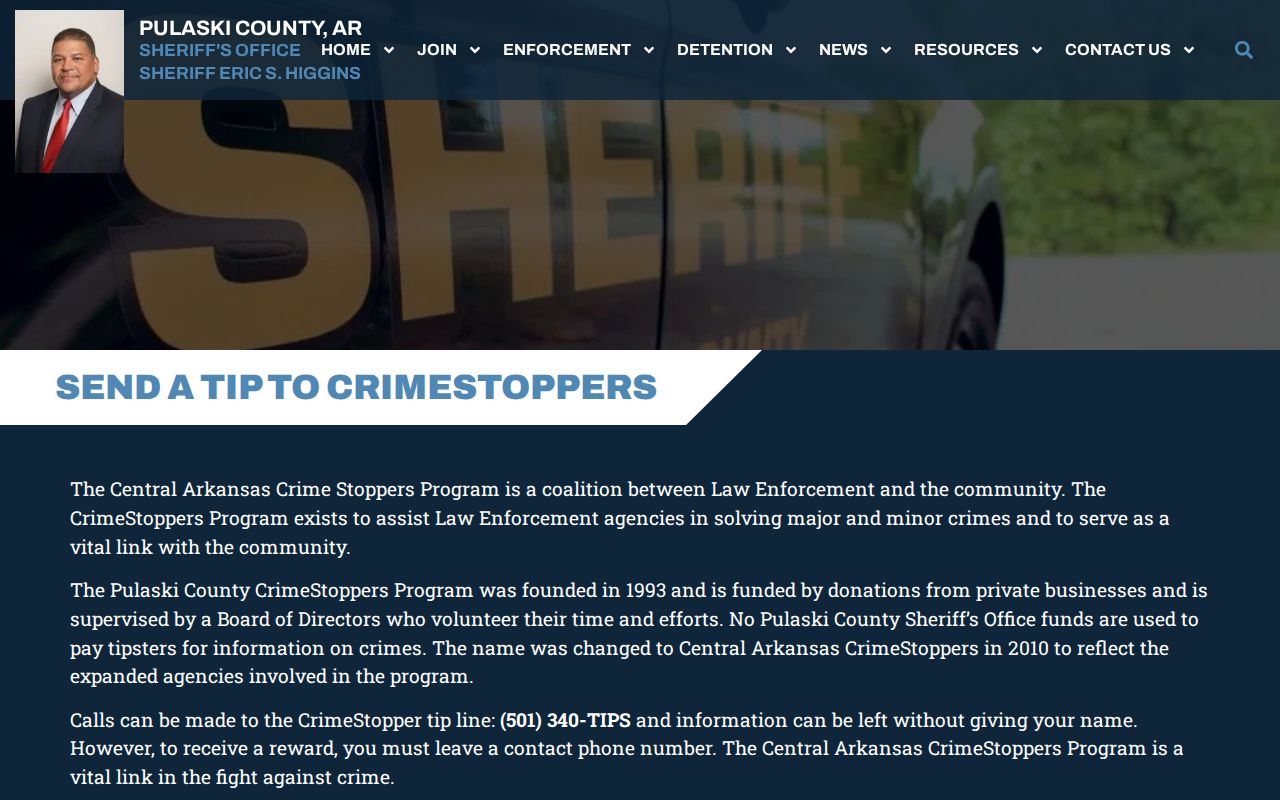
The image documents where Pulaski County directs non-emergency tip information. It is not a list of suspects and establishes nothing about who is wanted.
Pulaski Wanted Posts Versus Warrants
A wanted post is publicity chosen for one case. A warrant check is an individualized status inquiry. Even where agencies publish wanted photos, the set stays selective. It can never be read as the complete warrant inventory. In Pulaski County the line is sharper still, because no stable local gallery was verified at all.
PCSO posts on Facebook, X, Instagram, and Nextdoor for incident, traffic, and community updates. A wanted or suspect image may appear there when an event calls for public help. Nothing about those channels promises systematic posts or a fixed cadence. There is no standing "Warrant Wednesday" feature. No PCSO-branded inmate mobile app was verified either. The official browser roster does a different job. It presents detention custody after a person has been booked.
Arkansas VINE can send custody-status notifications. But it is not a warrant service, a photo archive, or a court-history source. A VINE alert starts only after a participating custody record exists. When the question is whether a warrant remains valid, it cannot replace the issuing court.
Pulaski County Warrant Status Changes
Warrant details go stale fast. At PCSO, Communications staff verify each warrant and update the ACIC and NCIC entries once it is served. That internal workflow can run ahead of a public court page or an old news story. A docket may show that a judge issued process yet say nothing about what happened later, whether officers served it, the court recalled it, or a new order changed things. Write down the date and source each time you check. Then get the unit or court in charge to confirm the current status directly.
Names collide constantly in a county this size. One full name may fit two different people, and public staff often want more detail before they discuss anything. A case number, a court name, and a dated docket entry beat photo matching or social posts every time. If Search ARCourts or CourtConnect returns nothing, call the clerk instead of assuming no warrant exists. Arkansas Judiciary is rebuilding its public search systems too, and some district criminal and traffic functions were still in progress.
Serving a Pulaski County warrant can generate several records rather than one. The docket captures the judicial side. The arresting agency may file an incident or arrest report. PCRDF adds a booking record only if the person actually enters county custody. Someone might instead be cited, released, transferred, or held for another authority. The Pulaski County roster is therefore not a warrant database. It answers who is detained right now, while Records/Warrants and the issuing court answer whether process remains active.
Note: Date every warrant check because service, recall, court orders, and system updates can change status after an earlier result.
Resolve Pulaski County Warrants Safely
Never confront someone over a web post. Do not follow, photograph, or approach them. Photos go stale. Names match the wrong people. Warrants themselves can change after publication. Call 911 only for an immediate threat. Otherwise, pass what you know to CrimeStoppers or the responsible agency and let trained staff take it from there.
Think a Pulaski County warrant names you? Call a lawyer, the issuing court, or Records/Warrants. That is a path to resolution, not a dodge of lawful process. Counsel or the court can walk through appearance, surrender, bond, and scheduling, all of which depend on the specific order. A clerk can also sort out where a case belongs when the public search leaves you guessing.
Once things move forward, follow the court docket for the latest dated event and the final outcome. People leave the Pulaski County Regional Detention Facility for many reasons: bond, transfer, a court order, sentence completion, or some other custody change. Release by itself settles nothing about the case. The court record is what closes that gap.